A Summer Debate on Destiny
Free will, determinism, cellular automata and the universe.
Lying on the sand under the summer sun, my friend turned to me with a question: “Do you believe in destiny?” Cheesy. Cliché. It was the kind of question that felt almost ridiculous coming from someone I’d drunkenly made out with the night before. For a moment, I braced myself, hoping this wasn’t a prelude to whether our meeting was somehow “written in the stars.”
Thankfully, it wasn’t. He meant destiny in the existential sense—a question about life’s grand narrative, not ours specifically.
I asked how he would define destiny; is destiny just the lack of free will? The idea that everything was already predetermined, and we are just playing it out?
Our entire political and judicial systems are based upon the idea of our own free will, the idea that we are to control our actions and thus take responsibility for their outcomes.
Free will hinges on the rejection of determinism. In other words, if it’s already certain what will happen in the future, how could our will be free in any meaningful sense?
So then what is on the opposite side of the spectrum of determinism? Total and complete randomness. But that wouldn’t be free either would it? If free will just means that your actions can be boiled down to totally random processes, then that also takes away the idea that we have choice and intention behind our will as well.
So where between the two extremes of determinism and quantum randomness does free will lie?
Stephen Wolfram: A New Kind of Science
In 2002, physics and computer scientist Stephen Wolfram published A New Kind of Science, a book to introduce phenomena that hold both deterministic and nondeterministic properties: mathematical objects called cellular automata.
Stephen Wolfram began research in applied quantum field theory and particle physics and published scientific papers in peer-reviewed scientific journals at age 15. He attended the California Institute of Technology, where he received a PhD in particle physics in 1980. Wolfram's thesis committee was composed of the dream team Richard Feynman, Peter Goldreich, Frank J. Sciulli and Steven Frautschi, and chaired by Richard D. Field. Following his PhD, Wolfram joined the faculty at Caltech and became the youngest recipient of a MacArthur Fellowship in 1981, at age 21.
So What Is It, Cellular Automata?
Imagine a grid. A simple, unassuming grid, like the kind you’d find in a grade-school notebook or on a poorly thought-out kitchen floor. Now imagine that each square in this grid—each cell—is alive. Not alive in the heart-beating, oxygen-breathing sense, but alive in its ability to act, to change, to respond. Cellular automata (CA) is this world in miniature: a universe where the laws of life and motion can be boiled down to a set of deceptively simple rules.
At its core, cellular automata is a mathematical model, an abstraction of life distilled into the bare essentials. The grid could stretch infinitely, or it could wrap around like the surface of a torus (fancy for “donut-shaped”), but let’s start small—a finite grid, perhaps the size of a Post-it. Each square in this grid can be in one of a few states. Often, it’s binary: on or off, alive or dead, black or white.
The magic happens in the transitions. Cellular automata doesn’t live in the moment; it thrives in the next. Each cell’s fate—whether it remains as it is or transforms—depends entirely on its neighbors. Think of it like a local gossip chain: what happens to you depends on who’s standing next to you and what they’re up to.
Take the infamous “Game of Life,” invented by mathematician John Conway in 1970. Here, each square follows just four rules:
- A living cell with too few neighbors (less than two) dies of loneliness.
- A living cell with too many neighbors (more than three) dies of overcrowding.
- A dead cell with exactly three living neighbors springs to life, as though the conditions for life were just right—Goldilocks reincarnate.
- Otherwise, cells stay as they are.
That’s it. Four lines of logic. But the outcomes? Oh, the outcomes are kaleidoscopic. Patterns emerge, not because anyone designed them, but because the rules themselves are designed to unleash emergence. You’ll see still-lifes—structures that never change. Gliders that seem to crawl across the grid. Oscillators, pulsing hypnotically. From simplicity, complexity erupts.
But cellular automata isn’t just about mesmerizing patterns. It’s a metaphor—a way to think about the world. These grids mimic systems everywhere: the spread of disease, the ebb and flow of ecosystems, the behavior of traffic jams. It’s rules-based chaos, a microscopic stage for the fight between order and disorder.
And perhaps what’s most humbling about cellular automata is how small its building blocks are. It reminds us that complexity, whether in nature, society, or our own minds, doesn’t always stem from intricate design. Sometimes, the whole is greater than the sum of its parts simply because the parts played their roles so faithfully.
So here we are: a humble grid, simple rules, and yet, an entire cosmos unfolding square by square. It’s not just a mathematical toy; it’s a reminder that the universe itself may be written in the quiet logic of tiny, rule-bound steps. From the micro to the macro, cellular automata lets us glimpse the infinite, one square at a time.
Wolfram’s Four Classes
Wolfram grouped cellular automata into four broad behavioral classes, based on how they evolve over time. These classes describe the qualitative nature of the system's output:
Class 1: Fixed or Homogeneous Behavior
Behavior: The system quickly stabilizes into a uniform, fixed state (e.g., all cells turn “off” or “on”).
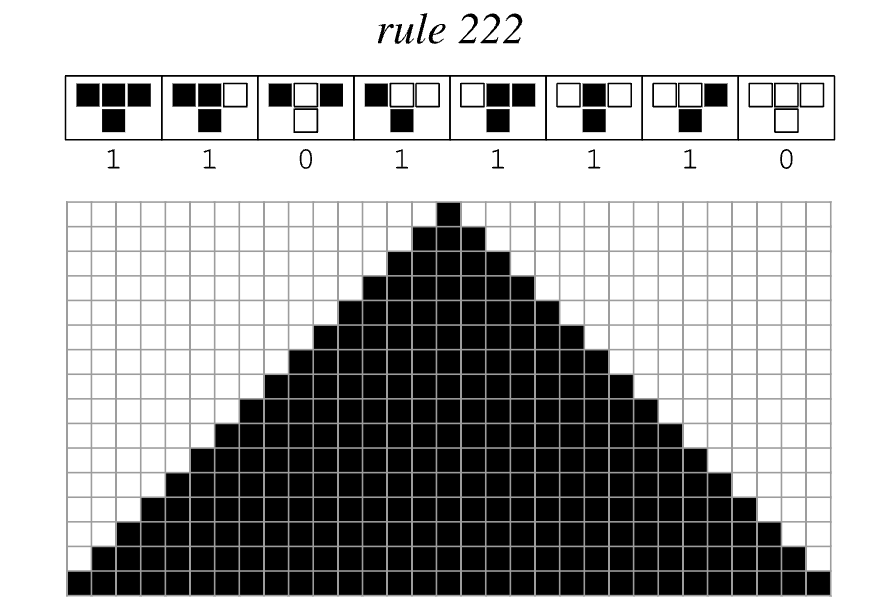
Example: Rule 222.
Analogy: Pouring water into a mold—it conforms and settles without surprises.
Implications: Predictable and unchanging; not particularly interesting for modeling complex systems.
For each cell, there are eight possible combinations of states for the three cells bordering it in the previous step. If we start with a single black cell and compute the progression of the cells with one row after another by applying rule 222, we obtain a very predictable pattern. If you were to guess the millionth cell, or the million to the millionth cell from this rule, you could just answer “black”. This is how science is “supposed” to work. In other words, once we find the deterministic rules to describe a phenomena, you can apply those deterministic rules to discern predictable outcomes. However, not all the other classes are as predictable.
Class 2: Periodic or Oscillatory Behavior
Behavior: The system settles into a repeating pattern or oscillates between a few states.
Example: Rule 94.
Analogy: A pendulum swinging back and forth—predictable cycles.
Implications: Captures systems with simple periodicity, like binary signals or basic wave phenomena.
Class 3: Chaotic or Random Behavior
Behavior: The system evolves in a seemingly random, chaotic way, though it is deterministic.
Example: Rule 30.
Analogy: Smoke rising unpredictably but still shaped by physical laws.
Implications: Useful for generating pseudo-randomness; resembles turbulence or entropy-driven systems.
Class 4: Complex or Computationally Rich Behavior
Behavior: The system produces intricate, structured patterns that may exhibit both localized stability and chaotic regions.
Example: Rule 110.
Analogy: Life itself—a mix of order and chaos, capable of computation and adaptation.
Implications: These automata are the most fascinating and mysterious, as they can simulate universal computation and are akin to natural processes like crystal growth or biological evolution.
Although the images produced by class 4 rules look random like the rules in class three, they are not deterministic in the same predictable sense. There is no way to determine what the thousandth row will be, or the million to the millionth row, other than to compute them one by one.
This means that systems based on class 4 properties—like our own universe, Wolfram argues—possess an irreducible complexity that defies the old, reductive versions of determinism.
This demonstrates a property called emergence. In essence, emergence is very simple things, collectively, giving rise to much more complex things. Simple rules—when left to play out—create the spectacularly intricate fractal structures in nature: branching of trees, the stripes of zebras, the mesmerizing coils of a shell. Even consciousness, that ineffable experience we call “I,” might be an emergent property of the brain’s neurons firing in binary harmony.
Somehow, these simple, stepwise interactions generate our individual subjective experience. In the interplay of Class 4 rules lies the philosophical kernel of why we exist at all. If the universe were a Class 1 system, we’d be static, unthinking bots. A Class 2 cosmos would repeat itself ad nauseam. Class 3 would dissolve into chaos. Only Class 4 strikes the precarious balance straddling the boundary between order and chaos that allows for complexity, life, and reflection.
The point here is that if the rules of the universe resemble those of cellular automata, they can only be expressed through step-by-step unfolding—through reality actually happening. There’s no cheat code, no summarizing algorithm to “look ahead.” If reality works this way, it suggests the universe lacks a shortcut to its own future; it must play out in real time.
By contrast, a universe governed by deterministic rules without automata-like emergence, or one rooted solely in randomness, wouldn’t require the sequential unfolding we observe. It would either stagnate in mechanical predictability or disintegrate into unstructured chaos.
But if consciousness—and by extension, existence itself—arises only from the intricate balance of order and chaos found in Class 4 automata, then these rules provide a philosophical argument for why we exist—without such rules, we wouldn’t be here to ponder the question.
I can’t say I know that much about anything in regards to the way the universe works, but I would say that is one of the best explanations of human existence that I have seen.